
AI in digital marketing is changing how businesses attract customers, create content, manage campaigns, and understand their audiences. From generating content ideas to analyzing marketing performance, artificial intelligence is helping marketers complete many tasks more efficiently.
In 2026, businesses do not need to use complicated technology to benefit from AI. Many accessible tools can help with content creation, SEO research, social media planning, email marketing, customer support, and advertising.
However, successful marketing is not just about using AI tools. Businesses still need a clear strategy, original ideas, accurate information, and a good understanding of their customers.
In this guide, we will explore how to use AI in digital marketing, practical strategies for businesses, useful AI tools, and ways to build an effective marketing workflow in 2026.
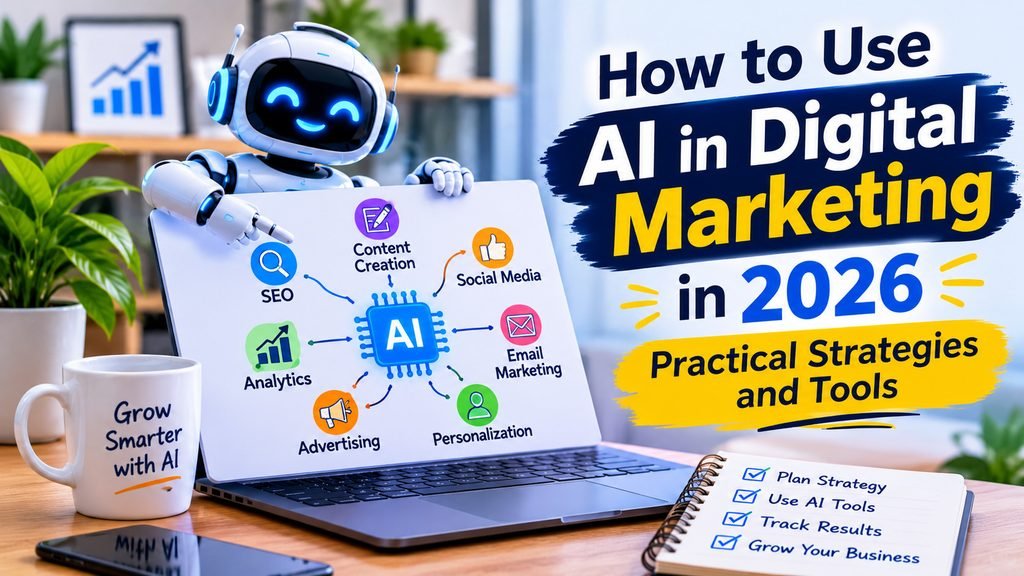
What Is AI in Digital Marketing?
AI in Digital Marketing means using artificial intelligence technologies to support and improve marketing activities. These technologies can analyze information, recognize patterns, generate suggestions, automate certain tasks, and help marketers make better-informed decisions.
For example, AI tools can help businesses:
- Generate blog post ideas and content outlines.
- Research keywords and analyze search intent.
- Create social media captions.
- Personalize email campaigns.
- Analyze advertising performance.
- Organize customer inquiries.
- Generate marketing reports.
- Discover patterns in customer behavior.
The purpose of AI in digital marketing is not to replace every human task. It is to help marketing teams work more efficiently while keeping creativity, strategy, and decision-making under human control.
Why Is AI in Digital Marketing Important in 2026?
Digital marketing involves many activities, and managing all of them manually can take considerable time. AI tools can assist with repetitive tasks and help marketers work with information more efficiently.
Here are some important benefits of AI in digital marketing:
1. Saves Time
AI can help create first drafts, summarize information, organize ideas, and prepare campaign outlines. This gives marketers more time to focus on planning and improving their campaigns.
2. Supports Better Content Planning
AI tools can suggest topics, related questions, content formats, and headline ideas based on your audience and marketing goals.
3. Helps Understand Customers
Some AI-powered analytics tools can identify patterns in customer interactions and campaign performance. These insights can help businesses understand what their audiences respond to.
4. Supports Personalization
AI can help businesses organize audience segments and prepare more relevant messages for different customer groups.
5. Improves Marketing Workflows
From scheduling content to preparing reports, AI can support several repetitive marketing activities.
However, AI does not automatically make a campaign successful. Results still depend on the quality of your strategy, data, content, and execution.
10 Practical Ways to Use AI in Digital Marketing in 2026
Let’s explore practical ways businesses can use AI to improve their marketing activities.
1. Use AI for SEO and Keyword Research
SEO is one of the most useful areas where AI can support digital marketing. AI-powered tools can help marketers brainstorm keyword ideas, understand search intent, organize topics, and prepare content outlines.
For example, if your business offers digital marketing services, you can use AI to explore topics such as:
- SEO strategies for small businesses.
- Content marketing tips.
- Local SEO techniques.
- Digital marketing tools.
- Social media marketing strategies.
You can use tools such as ChatGPT to generate keyword ideas and organize related topics. Dedicated SEO platforms can then help you evaluate search volume, competition, and keyword opportunities.
How to use AI for SEO:
- Enter your website topic or business niche.
- Ask AI to suggest relevant keyword ideas.
- Group related keywords by search intent.
- Review the suggestions using an SEO research tool.
- Select relevant keywords for your content.
- Create useful articles that answer readers’ questions.
Using AI in digital marketing for keyword research can make planning easier, but always verify keyword data before choosing your target phrases.
2. Create Better Content with AI Tools
Content marketing requires regular research, writing, editing, and planning. AI can assist with several parts of this process.
AI writing assistants can help you:
- Generate blog post ideas.
- Create article outlines.
- Prepare social media captions.
- Rewrite unclear sentences.
- Suggest headlines.
- Summarize research.
- Create email drafts.
For example, you can ask an AI assistant to create a blog outline about SEO for beginners. You can then review the outline, add useful examples, verify information, and write the final article.
The best approach to AI in digital marketing is to use AI as a writing assistant rather than publishing every generated response without review.
Your content should provide original value, accurate information, and practical insights for readers.
3. Improve Social Media Marketing with AI
Managing multiple social media platforms can be time-consuming. AI tools can help businesses plan content and prepare posts for different platforms.
You can use AI to:
- Generate Instagram caption ideas.
- Create LinkedIn post drafts.
- Prepare Facebook content.
- Suggest hashtags.
- Build a weekly content calendar.
- Adapt one topic into different content formats.
- Brainstorm short-video concepts.
For example, a single blog post can become several social media posts, a short video script, and an email newsletter.
This makes AI in digital marketing useful for businesses that want to maintain a consistent publishing schedule.
Always adjust the tone and format for each platform. A professional LinkedIn post may need a different approach from an Instagram caption.
4. Use AI for Email Marketing
Email marketing helps businesses communicate with subscribers, share updates, and promote relevant products or services.
AI can support email marketing by helping with:
- Subject line ideas.
- Email content drafts.
- Audience segmentation ideas.
- Campaign planning.
- Message personalization.
- Performance summaries.
For example, an online store may create different email campaigns for new subscribers and returning customers.
AI can help prepare the drafts, but businesses should review the content, check personalization details, and follow applicable email marketing and privacy requirements.
With AI in digital marketing, email campaigns can become easier to plan and manage without losing the human touch.
5. Improve Customer Support with AI Chatbots
AI chatbots can help businesses respond to common customer questions. They can provide basic information, guide visitors to relevant pages, and collect inquiries.
Examples include questions about:
- Business opening hours.
- Service details.
- Pricing information.
- Delivery policies.
- Appointment procedures.
- Frequently asked questions.
A chatbot can be useful when a business receives similar questions regularly.
However, businesses should provide a way for customers to contact a human representative when a chatbot cannot answer correctly.
When using AI in digital marketing for customer support, make sure the chatbot provides accurate information and does not make promises that your business cannot fulfill.
6. Use AI for Paid Advertising
Paid advertising platforms already use automation and machine learning to support campaign delivery, audience selection, and bidding.
AI tools can also help marketers prepare advertising ideas and analyze campaign performance.
You can use AI to:
- Generate ad headline variations.
- Prepare different descriptions.
- Brainstorm creative concepts.
- Organize audience research.
- Summarize campaign reports.
- Identify possible areas for improvement.
For example, a business promoting a digital marketing service can create several ad message variations and test which ones attract relevant visitors.
AI in digital marketing can support advertising decisions, but marketers should monitor budgets, conversion quality, and campaign performance instead of relying entirely on automated suggestions.
7. Personalize the Customer Experience
Customers often respond better to content and offers that match their interests and needs.
AI can help businesses organize customer information and identify patterns that support relevant communication.
Examples include
- Recommending related products.
- Showing relevant website content.
- Organizing subscribers into audience segments.
- Preparing personalized email messages.
- Suggesting relevant content based on user interests.
Personalization should always respect customer privacy and applicable data protection rules.
Use information responsibly and avoid collecting or processing personal data without an appropriate legal basis.
8. Analyze Marketing Data with AI
Marketing campaigns generate information about website visits, clicks, conversions, and customer interactions.
AI-powered analytics features can help marketers summarize this information and identify possible patterns.
You can use AI to support:
- Website traffic analysis.
- Campaign performance reviews.
- Customer behavior summaries.
- Content performance comparisons.
- Conversion analysis.
- Marketing report preparation.
For example, you can review a campaign report and ask an AI assistant to summarize which traffic sources generated the most conversions.
Before making decisions, verify the figures and compare them with the original analytics data.
One of the biggest advantages of AI in digital marketing is the ability to turn large amounts of information into more understandable insights.
9. Create Visual Content with AI
Visual content is important for websites, advertisements, and social media platforms. AI image-generation and design tools can help marketers explore creative ideas and prepare visual concepts.
Businesses can use AI to assist with:
- Blog featured image concepts.
- Social media graphics.
- Advertisement concepts.
- Presentation visuals.
- Infographic ideas.
- Campaign design inspiration.
Tools such as Canva and AI image generators can support visual content workflows.
However, always review generated images for accuracy, brand consistency, licensing requirements, and suitability for your audience.
10. Automate Repetitive Marketing Tasks
Marketing teams often spend time on repetitive activities such as organizing content ideas, preparing reports, and moving information between applications.
AI-powered automation tools can help connect different parts of a marketing workflow.
Examples include
- Sending form submissions to a CRM.
- Organizing new leads.
- Preparing weekly campaign summaries.
- Creating content task lists.
- Scheduling approved social media posts.
- Sending notifications when a new inquiry arrives.
Automation should be tested carefully. Keep human approval for important actions such as sending promotional campaigns, changing advertising budgets, or responding to sensitive customer requests.
Best AI Tools for Digital Marketing in 2026
There are many tools available to support different marketing tasks. The best option depends on your business goals, budget, and workflow.
Here are some popular tools worth exploring:
1. ChatGPT
ChatGPT can help with content brainstorming, writing drafts, keyword ideas, marketing strategies, research organization, and campaign planning.
It is useful for businesses that need assistance with multiple types of marketing tasks.
2. Google Gemini
Google Gemini can assist with research, brainstorming, writing, and working with information. Its available features depend on the product version and plan.
3. Canva
Canva helps businesses create social media graphics, presentations, marketing visuals, and other design materials. Its AI features can support parts of the creative process.
4. Semrush
Semrush provides SEO and digital marketing research features, including keyword research, competitor analysis, and website auditing. Some AI-powered features are also available.
5. HubSpot
HubSpot provides marketing, sales, and customer relationship management tools. Its AI features can assist with content, customer workflows, and marketing activities depending on the plan.
6. Grammarly
Grammarly helps users review writing, improve clarity, and check grammar. Its AI-powered writing features can also support editing and drafting.
7. Mailchimp
Mailchimp provides email marketing and automation features. Depending on the plan, businesses can use tools that assist with campaign creation and audience management.
Choose tools based on the task you need to complete. You do not need to subscribe to every AI platform to build an effective marketing strategy.
How Small Businesses Can Use AI in Digital Marketing
Small businesses often have limited budgets and smaller marketing teams. AI tools can help them manage everyday marketing activities more efficiently.
Here is a simple example of how a small business can use AI:
Step 1: Plan content
Use an AI assistant to brainstorm blog topics and social media ideas based on your business niche.
Step 2: Research keywords.
Generate keyword ideas with AI and verify them using an SEO tool.
Step 3: Create content
Prepare article outlines, captions, and email drafts. Add your own experience and verify the information.
Step 4: Design visuals
Use a design platform to create relevant graphics and marketing materials.
Step 5: Publish and promote
Share approved content on your website, email newsletter, and social media platforms.
Step 6: Review performance.
Use analytics tools to understand traffic, engagement, and conversions.
This simple workflow shows how AI in digital marketing can support small businesses without requiring a large marketing department.
Common Mistakes to Avoid When Using AI in Digital Marketing
AI can be helpful, but using it incorrectly can create problems for your marketing strategy.
Avoid these common mistakes:
1. Publishing Unchecked AI Content
AI-generated content can contain inaccurate or outdated information. Always review facts, examples, and recommendations before publishing.
2. Ignoring Your Target Audience
Content should answer real customer questions. Do not create articles simply because an AI tool suggests a topic.
3. Depending Completely on Automation
Automation can save time, but human review is important for brand communication, customer support, and important business decisions.
4. Using AI Without a Clear Strategy
Choose tools based on your marketing goals instead of using AI simply because it is popular.
5. Ignoring Privacy
Handle customer information responsibly. Follow relevant privacy requirements and the policies of the platforms you use.
6. Focusing Only on Quantity
Publishing more content does not automatically produce better results. Focus on usefulness, accuracy, originality, and relevance.
How to Build an AI-Powered Digital Marketing Strategy
A successful strategy begins with clear goals. Before choosing AI tools, decide what you want your marketing activities to achieve.
Follow these steps:
- Define your goals: Decide whether you want more website traffic, leads, sales, or brand awareness.
- Understand your audience: Identify customer needs, interests, and common questions.
- Choose suitable tools: Select tools that support your actual marketing tasks.
- Create a workflow: Decide where AI can assist with research, writing, design, and analysis.
- Review AI output: Verify facts and maintain your brand’s voice.
- Measure performance: Track relevant metrics and compare results.
- Improve continuously: Use your findings to refine future campaigns.
The most effective use of AI in digital marketing combines automation with human creativity, expertise, and strategic thinking.
Frequently Asked Questions
1. What is AI in Digital Marketing?
AI in Digital Marketing means using artificial intelligence tools and technologies to support marketing activities such as content creation, SEO, advertising, email campaigns, customer support, and data analysis.
2. Which AI tools are best for digital marketing beginners?
Beginners can explore ChatGPT for content and brainstorming, Canva for visual design, Grammarly for writing assistance, and Google Gemini for research and productivity. Choose tools according to your needs and budget.
3. Can AI help improve SEO?
Yes. AI can assist with keyword brainstorming, content outlines, search intent research, and content editing. However, keyword data should be verified using SEO tools, and content should provide genuine value to readers.
4. Can small businesses use AI in digital marketing?
Yes. Small businesses can use AI to prepare content, organize marketing activities, create visuals, analyze campaign reports, and support customer communication.
5. Will AI replace digital marketers?
AI is changing marketing workflows, but businesses still need people for strategy, creativity, judgment, customer understanding, and responsible decision-making. AI is best viewed as a tool that supports marketing professionals.
6. Is AI-generated content good for SEO?
AI-generated content is not automatically good or bad for SEO. The important factors are usefulness, originality, accuracy, and whether the content is created to help people. Review and improve AI-assisted content before publishing.
Conclusion
AI in digital marketing is creating new opportunities for businesses to plan campaigns, create content, understand customers, and improve marketing workflows in 2026.
From SEO and social media to email marketing, advertising, and analytics, AI tools can support many everyday marketing activities. However, successful results require more than automation. Businesses must combine AI capabilities with human creativity, accurate information, customer understanding, and a clear strategy.
For Vyyntra, start by exploring a few useful AI tools and applying them to your existing content and marketing workflow. Test what works, measure the results, and improve your approach over time.
By using AI in digital marketing thoughtfully, businesses can build more efficient marketing processes and create better experiences for their audiences.
Visit Home