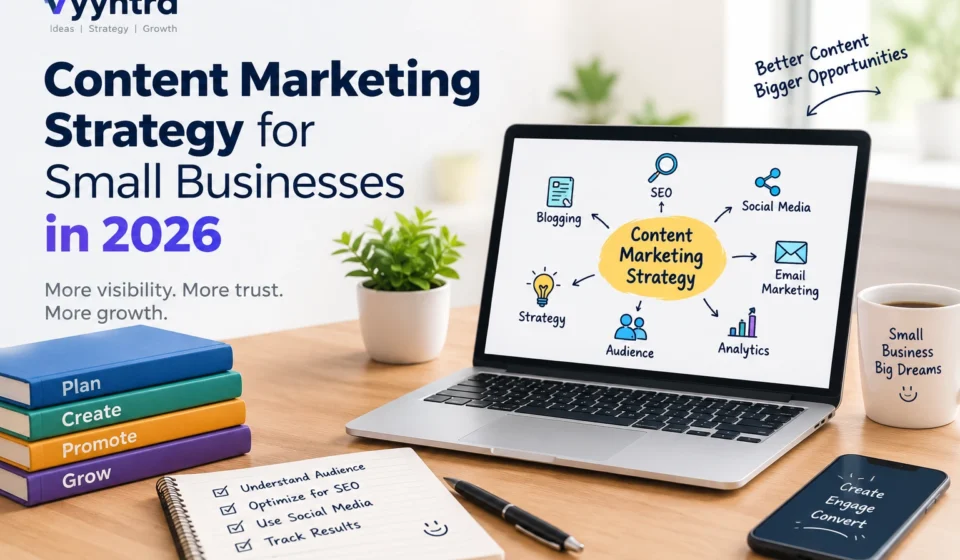

In today’s competitive digital world, having a strong online presence is essential for every small business. A well-planned content marketing strategy helps businesses attract potential customers, build trust, improve search engine visibility, and generate quality leads without relying entirely on paid advertising.
In 2026, content marketing continues to offer opportunities for small businesses through SEO, blogging, social media, email marketing, and AI-powered tools. The key is to create valuable content that answers customer questions and solves real problems.
In this guide, Vyyntra explores how to develop an effective content marketing strategy for small businesses in 2026 and use it to achieve sustainable online growth.
What Is a Content Marketing Strategy?
A content marketing strategy is a structured plan for creating, publishing, and promoting valuable content to reach a target audience and achieve business goals.
It includes understanding your customers, researching relevant keywords, planning blog topics, optimising website content, distributing articles across suitable platforms, and measuring performance.
For example, a digital marketing agency can publish educational articles about SEO, website optimisation, and lead generation to attract potential clients. Similarly, an online store can create product guides and buying advice to help customers make informed decisions.
A successful content marketing strategy focuses on providing value instead of simply promoting products or services.
Why Is Content Marketing Important for Small Businesses in 2026?
1. Improve Search Engine Visibility
Publishing helpful, SEO-friendly content can help your website appear for relevant search queries. By answering customer questions and covering important topics in your industry, you can build a stronger organic search presence over time.
2. Build Customer Trust
Customers appreciate businesses that provide clear information and practical solutions. Informative blog posts, tutorials, and industry guides demonstrate your knowledge and help establish credibility.
3. Generate Quality Leads
Content can attract visitors who are already interested in your products or services. Including relevant calls to action, such as contacting your team or requesting a quote, helps turn interested readers into potential customers.
4. Support Long-Term Growth
Unlike an advertisement that stops delivering paid exposure when a campaign ends, useful evergreen content can continue attracting visitors over time. Regular updates help keep that content accurate and relevant.
How to Create a Successful Content Marketing Strategy in 2026
Step 1: Understand Your Target Audience
Start by identifying your ideal customers, their challenges, their interests, and the questions they ask before making a purchase.
Use customer feedback, sales enquiries, keyword research, and website analytics to understand what your audience needs.
When you understand your audience, you can create content that provides relevant answers and practical solutions.
Step 2: Perform Keyword Research
Keyword research helps you discover the phrases people use when searching for information online.
For your content marketing strategy, focus on a primary keyword and related search terms that match your topic.
Useful keyword ideas include:
- Content Marketing Strategy for Beginners
- Content Marketing for Small Businesses
- SEO Content Strategy
- Digital Marketing Tips for Startups
- Content Marketing Trends in 2026
Tools such as Google Keyword Planner and Google Search Console can help you explore relevant search terms and understand how your website performs.
Use keywords naturally in your title, introduction, headings, and body content. Avoid excessive repetition and focus on answering the reader’s question.
Step 3: Publish High-Quality Blog Posts
Blogging is an effective way to educate your audience, answer common questions, and attract relevant website traffic.
Create content that offers actionable advice, original insights, useful examples, and clear explanations.
Consider publishing beginner’s guides, how-to articles, industry updates, case studies, and frequently asked questions.
A strong content marketing strategy prioritises helpful, original content rather than publishing large numbers of generic articles.
Step 4: Optimise Your Content for SEO
Search engine optimisation helps search engines understand your pages and makes it easier for users to find relevant information.
Follow these essential practices:
- Write clear and descriptive page titles.
- Create engaging meta descriptions.
- Use a logical heading structure.
- Add relevant internal links.
- Optimise images with descriptive alt text.
- Keep URLs short and readable.
- Ensure your website works well on mobile devices.
- Review website performance using Google Search Console.
Focus on search intent, readability, and user experience instead of trying to repeat your target keyword a specific number of times.
Step 5: Promote Your Content on Social Media
Creating content is only the first step. You also need to distribute it through channels where your audience spends time.
Share blog highlights, short videos, practical tips, infographics, and educational posts on relevant social media platforms.
You can also repurpose one detailed article into multiple smaller pieces of content. This saves time and helps your business reach different audience segments.
Step 6: Use AI Tools to Work More Efficiently
AI tools can help small businesses brainstorm topics, create outlines, organise research, and repurpose existing content.
However, review AI-assisted content carefully before publishing. Verify facts, improve generic explanations, and add original insights that reflect your experience and expertise.
The best content marketing strategy combines efficient technology with human creativity, accuracy, and a genuine understanding of customers.
Step 7: Measure Your Results
Tracking performance helps you understand whether your content is supporting your business goals.
Monitor important metrics such as organic traffic, search impressions, click-through rate, newsletter subscriptions, qualified leads, and conversions.
Use Google Analytics and Google Search Console to evaluate performance and identify opportunities for improvement.
Review your results regularly and update your content plan based on what works best for your audience.
Content Marketing Trends for Small Businesses in 2026
Several approaches can help businesses strengthen their content marketing strategy in 2026.
People-first content: Create useful articles that directly answer questions and provide meaningful information.
Short-form videos: Use concise videos to explain products, demonstrate services, and share practical tips.
Email newsletters: Build relationships with subscribers by sharing helpful information and relevant updates.
Topic clusters: Organise related articles around key subjects and connect them through internal links.
Content repurposing: Transform existing blog posts into videos, social media updates, newsletters, and other useful formats.
Small businesses should prioritise the trends that align with their audience, budget, and business objectives instead of trying every new marketing technique.
Common Content Marketing Mistakes to Avoid
Even a well-planned content marketing strategy can struggle when businesses overlook important fundamentals.
- Keyword stuffing: Repeating keywords excessively makes content difficult to read.
- Inconsistent publishing: Create a realistic schedule that your team can maintain.
- Ignoring search intent: Make sure your content answers the questions visitors actually have.
- Publishing generic content: Add useful examples, original insights, and accurate information.
- Neglecting older articles: Update outdated details and repair broken links.
- Ignoring analytics: Measure meaningful business results instead of focusing only on page views.
Avoiding these mistakes helps you create a more sustainable content marketing process.
Frequently Asked Questions
What is the best content marketing strategy for small businesses in 2026?
The best approach is to understand your audience, research relevant keywords, publish helpful content, optimise your website for SEO, distribute articles through appropriate channels, and measure results consistently.
How often should a small business publish blog posts?
Choose a realistic publishing schedule that allows you to maintain quality. One or two well-researched articles per month can be a practical starting point for a small business.
Does content marketing improve SEO?
High-quality, relevant content can help search engines understand your website and help users discover your pages. However, rankings and traffic are not guaranteed.
Can AI help with content marketing?
Yes. AI can support brainstorming, outlining, research organisation, and content repurposing. Human review is important to ensure accuracy, originality, and usefulness.
How long does content marketing take to show results?
Results vary depending on competition, content quality, website history, and distribution. Organic search growth may take several months or longer, so consistency and regular evaluation are important.
Conclusion
A strong content marketing strategy for small businesses in 2026 starts with understanding your audience and consistently publishing useful, relevant content.
From keyword research and SEO optimisation to social media promotion and performance tracking, every step should support a clear business objective.
Small businesses do not need enormous budgets to begin. They need a realistic plan, a commitment to quality, and a willingness to improve based on results.
At Vyyntra, we believe that valuable content is an important foundation for building trust, increasing online visibility, and supporting long-term digital growth.
Start building your content marketing strategy today and make every piece of content work towards a meaningful business goal.
Explore more digital marketing insights on Vyyntra to strengthen your online presence in 2026.
Visit home