
SEO vs Paid Ads: Driving consistent traffic is one of the biggest challenges for businesses competing online. Two of the most widely used ways to attract potential customers are Search Engine Optimization (SEO) and Paid Advertising.
Both channels can help businesses reach their target audience, but they work in different ways.
SEO focuses on building organic visibility and long-term search presence, while paid advertising allows businesses to place targeted ads in front of potential customers.
Understanding how each channel works can help businesses build a digital marketing strategy that fits their goals, audience, and budget.
1. What Is SEO?
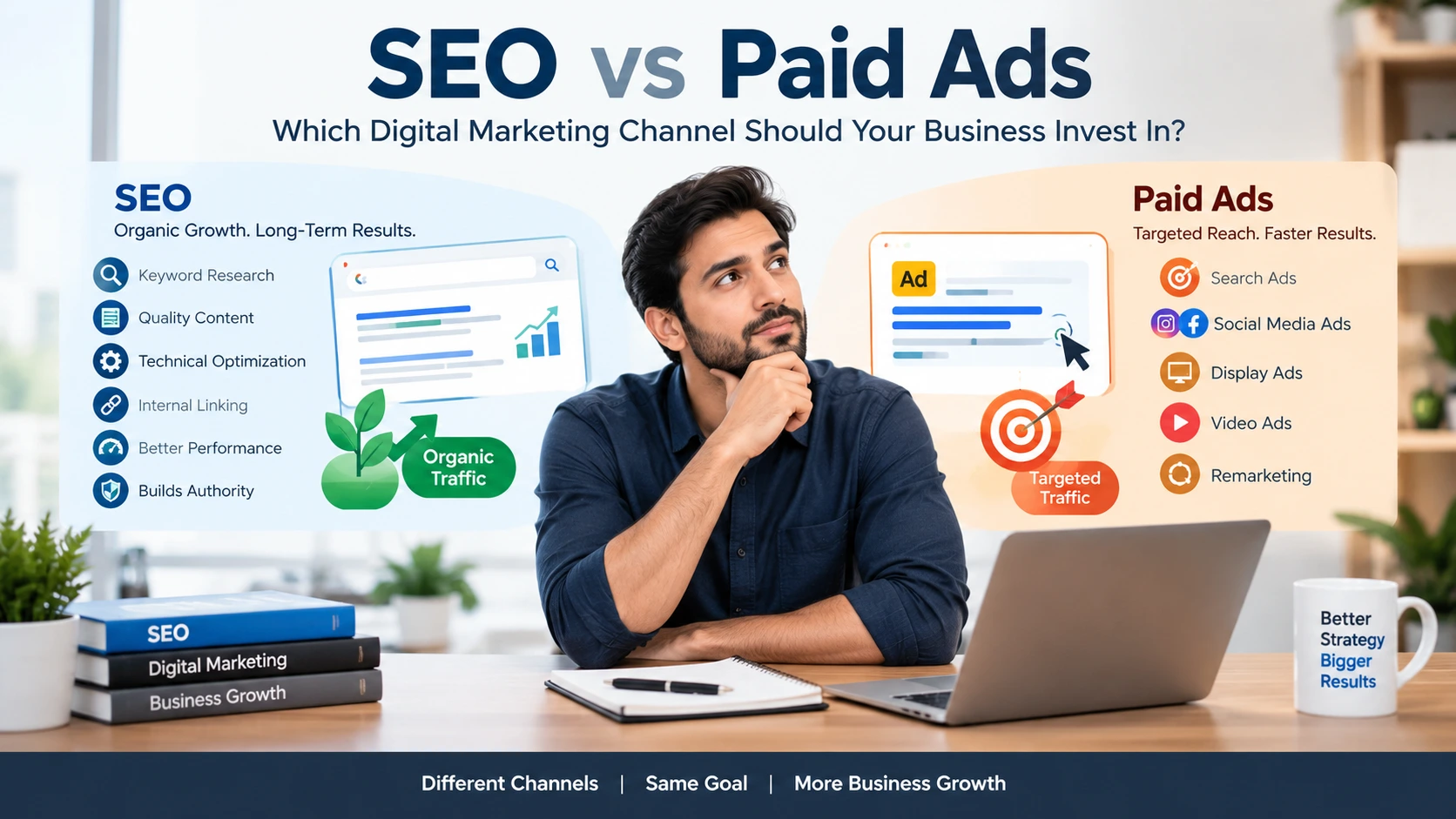
Search Engine Optimization (SEO) is the process of improving a website and its content so that it can appear more prominently in organic search results.
SEO typically involves:
- Keyword research
- High-quality content creation
- Technical website optimization
- Internal linking
- Website performance improvements
- Building relevant authority and credibility
The goal is to attract people who are already searching for information, products, or services related to your business.
Unlike paid advertising, organic search traffic doesn’t require paying for every individual click.
2. What Is Paid Advertising?
Paid advertising allows businesses to pay platforms to display advertisements to specific audiences.
Common forms of paid advertising include:
- Search engine ads
- Social media advertising
- Display advertising
- Video advertising
- Remarketing campaigns
Businesses can often define audiences using factors such as search queries, interests, demographics, location, or previous interactions with their website.
This allows campaigns to reach specific groups based on the targeting options available on the advertising platform.
3. SEO vs Paid Ads: How They Differ
Although both channels can generate website traffic, their approaches are different.
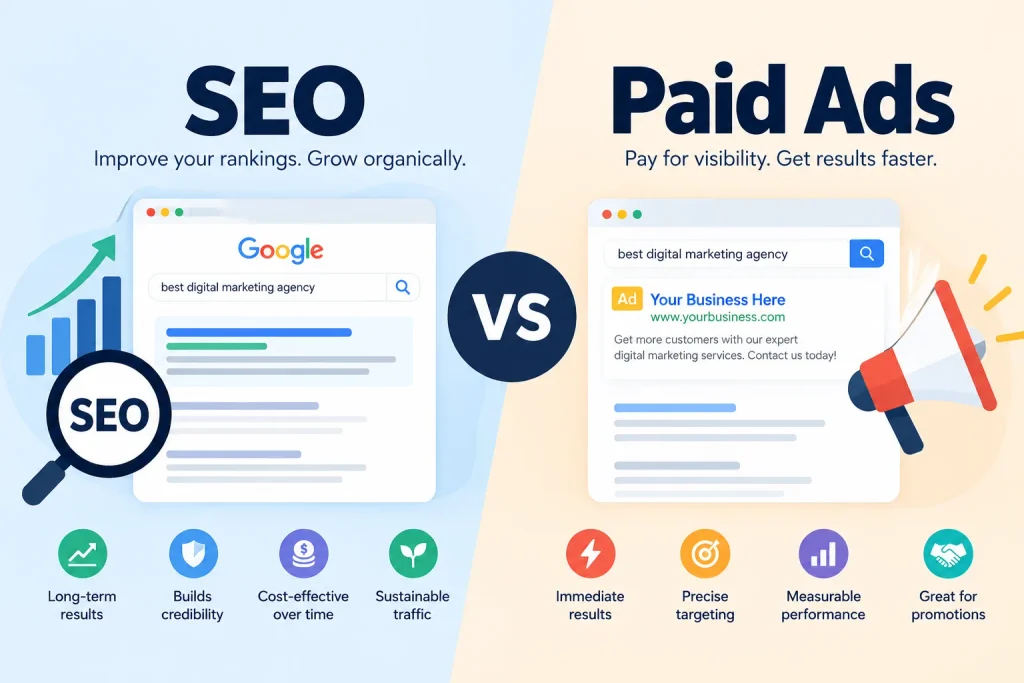
SEO
- Builds organic visibility
- Requires ongoing content and technical optimization
- Can take time to generate significant results
- Doesn’t charge per organic click
- Can support long-term search visibility
Paid Advertising
- Provides paid placement
- Can start generating traffic once campaigns are active
- Requires an ongoing advertising budget
- Offers campaign-level targeting and measurement
- Can be adjusted based on performance data
Neither channel operates in exactly the same way, so businesses should consider their specific objectives before choosing where to allocate resources.
4. When SEO Can Be Useful
SEO can be particularly relevant for businesses that want to build a long-term source of organic search visibility.
For example, businesses can create useful content around questions their potential customers are searching for.
A strong SEO strategy can include:
- Educational blog posts
- Service pages
- Product guides
- Comparison articles
- Frequently asked questions
- Topic-focused content clusters
The key is to create content that genuinely addresses search intent instead of producing pages solely around keywords.
5. When Paid Ads Can Be Useful
Paid advertising can be useful when a business wants to reach a specific audience through an active campaign.
For example, a business launching a new service may use paid search or social advertising to promote the offer to a defined audience.
Paid campaigns can also be used for:
- Product launches
- Limited-time promotions
- Lead generation
- Remarketing
- Event promotion
- Testing new offers
Because campaigns can be monitored using performance data, businesses can make adjustments to targeting, messaging, and budgets based on results.
6. Cost Considerations
SEO and paid advertising have different cost structures.
With paid advertising, businesses generally allocate a specific advertising budget and may pay based on metrics such as clicks or impressions, depending on the campaign model.
SEO involves investment in areas such as:
- Content creation
- SEO tools
- Technical optimization
- Website development
- SEO expertise
SEO may require more time before meaningful organic visibility develops, while paid advertising can generate traffic while campaigns are running.
Businesses should therefore consider both short-term campaign requirements and long-term marketing goals when planning their budgets.
7. SEO and Paid Ads Can Work Together
Businesses don’t necessarily have to choose only one channel.
SEO and paid advertising can complement each other as part of a broader digital marketing strategy.
For example:
SEO → Builds organic visibility
Paid Ads → Provides targeted campaign traffic
Content → Educates potential customers
Landing Pages → Convert visitors
Analytics → Measures performance
Using multiple channels can create a more connected customer journey and provide additional data about what audiences respond to.
8. Use Data to Improve Both Channels
Regardless of the channel you use, measurement is essential.
For SEO, businesses can monitor metrics such as:
- Organic traffic
- Search visibility
- Keyword performance
- Organic conversions
- Engagement metrics
For paid advertising, businesses can track:
- Click-through rate (CTR)
- Cost per click (CPC)
- Cost per lead (CPL)
- Conversion rate
- Return on ad spend (ROAS)
These metrics can help marketers identify opportunities to improve campaigns and website performance.
9. Build a Strategy Around Your Business Goals
Instead of asking whether SEO or paid advertising is universally better, start by identifying what your business actually needs.
Consider questions such as:
- Do you need traffic for a specific campaign?
- Are you building long-term organic visibility?
- What is your available marketing budget?
- How quickly do you need results?
- What channels does your target audience use?
- Which pages or offers are most important to your business?
Your answers can help determine how much attention should be given to SEO, paid advertising, or a combination of both.
Final Takeaway
SEO and paid advertising are two different approaches to generating digital visibility.
SEO focuses on building organic search presence over time, while paid advertising provides targeted visibility through advertising campaigns.
For many businesses, the most practical approach is to understand how both channels work and use them according to specific business objectives.
The right digital marketing strategy isn’t simply about generating more traffic. It’s about attracting the right audience, delivering relevant experiences, and turning that attention into measurable business results.
Frequently Asked Questions (FAQs)
1. Is SEO better than paid advertising?
Neither SEO nor paid advertising is universally better. SEO is generally focused on building long-term organic visibility, while paid advertising can provide targeted traffic more quickly. The right choice depends on your business goals, budget, audience, and timeline.
2. How long does SEO take to show results?
SEO can take several months to produce significant results, depending on factors such as competition, website authority, content quality, technical performance, and the search queries being targeted. SEO is generally considered a long-term marketing strategy.
3. Can paid ads provide faster results than SEO?
Yes. Paid advertising can begin generating traffic once campaigns are launched and approved. However, paid traffic generally requires an ongoing advertising budget, whereas organic SEO traffic does not involve paying for each individual click.
4. Is SEO cheaper than paid advertising?
The cost structure is different. Paid advertising usually requires an ongoing campaign budget, while SEO involves investments in content, technical optimization, tools, development, and expertise. The overall cost depends on the competitiveness of the market and the strategy being used.
5. Can a business use SEO and paid ads together?
Yes. SEO and paid advertising can complement each other. Businesses can use paid ads to generate immediate campaign traffic while developing SEO to build longer-term organic visibility.
6. Which is better for a new business: SEO or paid ads?
A new business may benefit from using both. Paid ads can help generate targeted traffic while the business builds its organic search presence through SEO. The appropriate balance depends on the available budget, business goals, and how quickly results are needed.
7. Do you have to pay for every click from SEO?
No. Organic search traffic generated through SEO does not involve paying a search engine for each click. However, maintaining SEO requires investment in areas such as content creation, technical optimization, and website improvements.
8. What are the main benefits of SEO?
Key benefits of SEO include building organic search visibility, attracting users who are actively searching for relevant information or services, supporting long-term traffic growth, and developing website authority and credibility.
9. What are the main benefits of paid advertising?
Paid advertising can provide targeted visibility, faster traffic generation, measurable campaign performance, and flexible control over factors such as budget, targeting, messaging, and campaign timing.
10. Should small businesses invest in SEO or paid ads?
Small businesses should choose based on their specific objectives and resources. SEO can help build long-term organic visibility, while paid ads can be useful for specific promotions, lead-generation campaigns, or situations where faster traffic is needed.
Visit Home